A signature, a gathering, a quire
Three words for nearly the same thing, and the small differences that still matter at the bindery. One of them gave this software its name, which seemed worth explaining.
A quire is a set of sheets folded together and nested one inside another, ready to be sewn. It is one of the oldest units of bookmaking, older than printing, and it is why the pages of a hardback come in clumps rather than as loose leaves.
A gathering is the same object, described from the binder's side of the bench. A signature is strictly the mark — a letter or number printed in the tail margin of the first page of each gathering, so the person collating them can see at a glance that gathering H follows G. The word slid across to mean the gathering itself, and now all three are used interchangeably by almost everyone.
Why the distinction is not pedantry
Because the signature mark is the only one of the three you can point at on a finished book. Open an older hardback at the spine and look at the bottom of the first page of each clump: the small letters are still there, doing the job they did in 1490.
The oldest example most people have seen
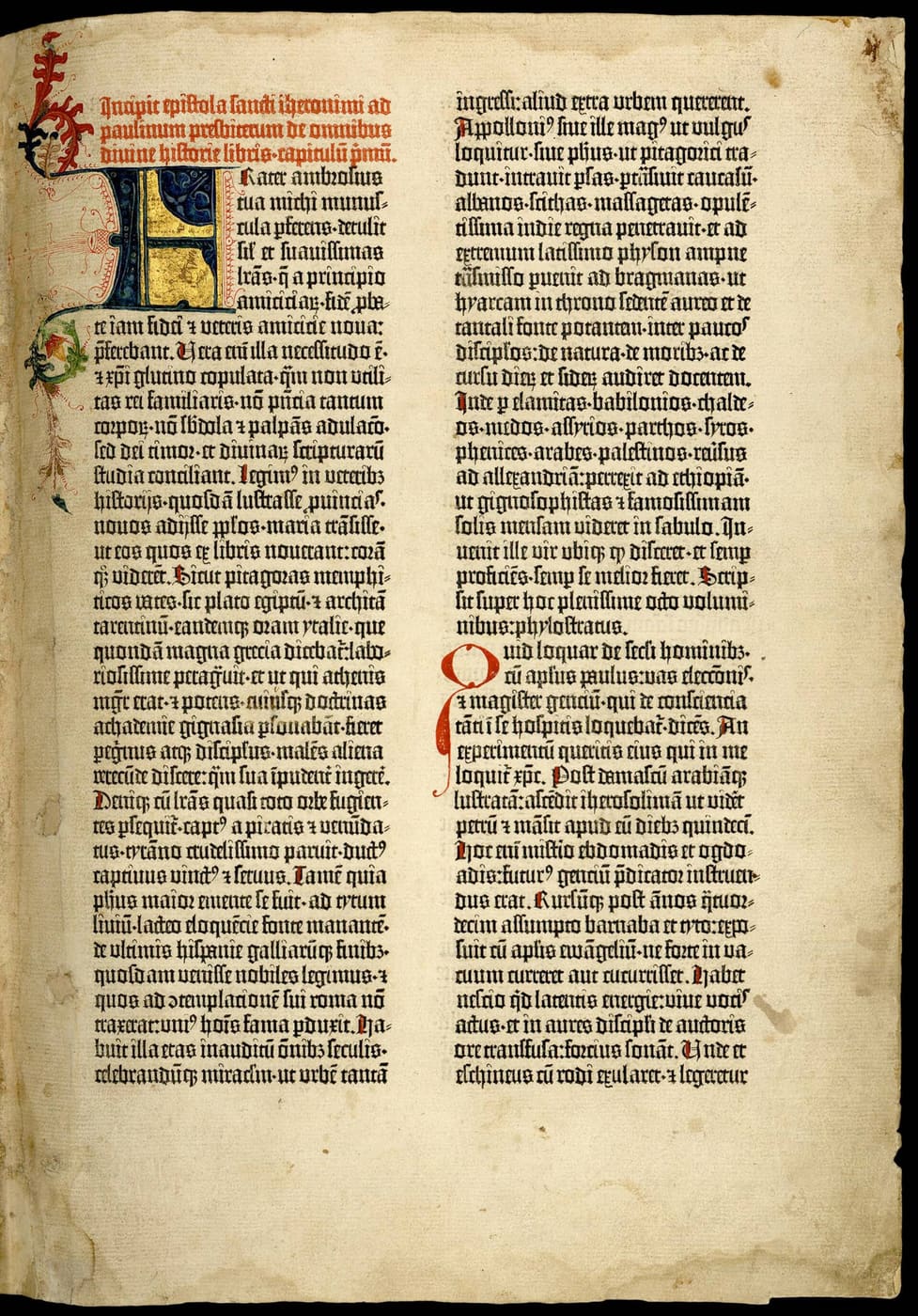
The page beside this paragraph is a leaf of the Gutenberg Bible, and it is quires all the way down. The book was printed around 1455 as some 320 gatherings, mostly of five sheets each — ten leaves, twenty pages — sewn one to the next. Every decision this site's Printing posts describe is already on it: two columns to keep the measure readable, margins in a canon a scribe would recognise, and a black dense enough that no reader ever wonders what the type is printed with.
What it does not have is the mark. Gutenberg's quires were collated by eye, and printed signature marks appear a generation later — which is the neatest proof that the mark is a workflow tool rather than a structural one. The structure was there first; the label was invented the first time somebody bound a book wrong.
Four leaves, eight pages
The commonest quire is four sheets folded once: eight leaves, sixteen pages. Hence quaternion, hence the Latin quaterni, four together, which is where the word itself comes from.
It is a good word for a thing made of folded sheets. That is what a book is, and it is what this software is named after.