Imposition: why page 1 sits beside page 8
Fold a sheet three times and the page order stops being obvious — page one ends up beside page eight, upside down. Printers solved this before 1500, and every book you own is still assembled by their answer.
A book is not printed a page at a time. It is printed on large sheets, each carrying many pages, which are then folded, cut and gathered. Working out which page goes where on the sheet, and which way up, is called imposition, and getting it wrong wastes the whole run.
Take one sheet folded three times: eight pages a side, sixteen in all. On the outer face, page 1 sits beside page 8, because after the fold those two ends meet. Half the pages are printed upside down relative to the other half. Hold a cheap paperback up to the light at the spine and you can still see the logic.
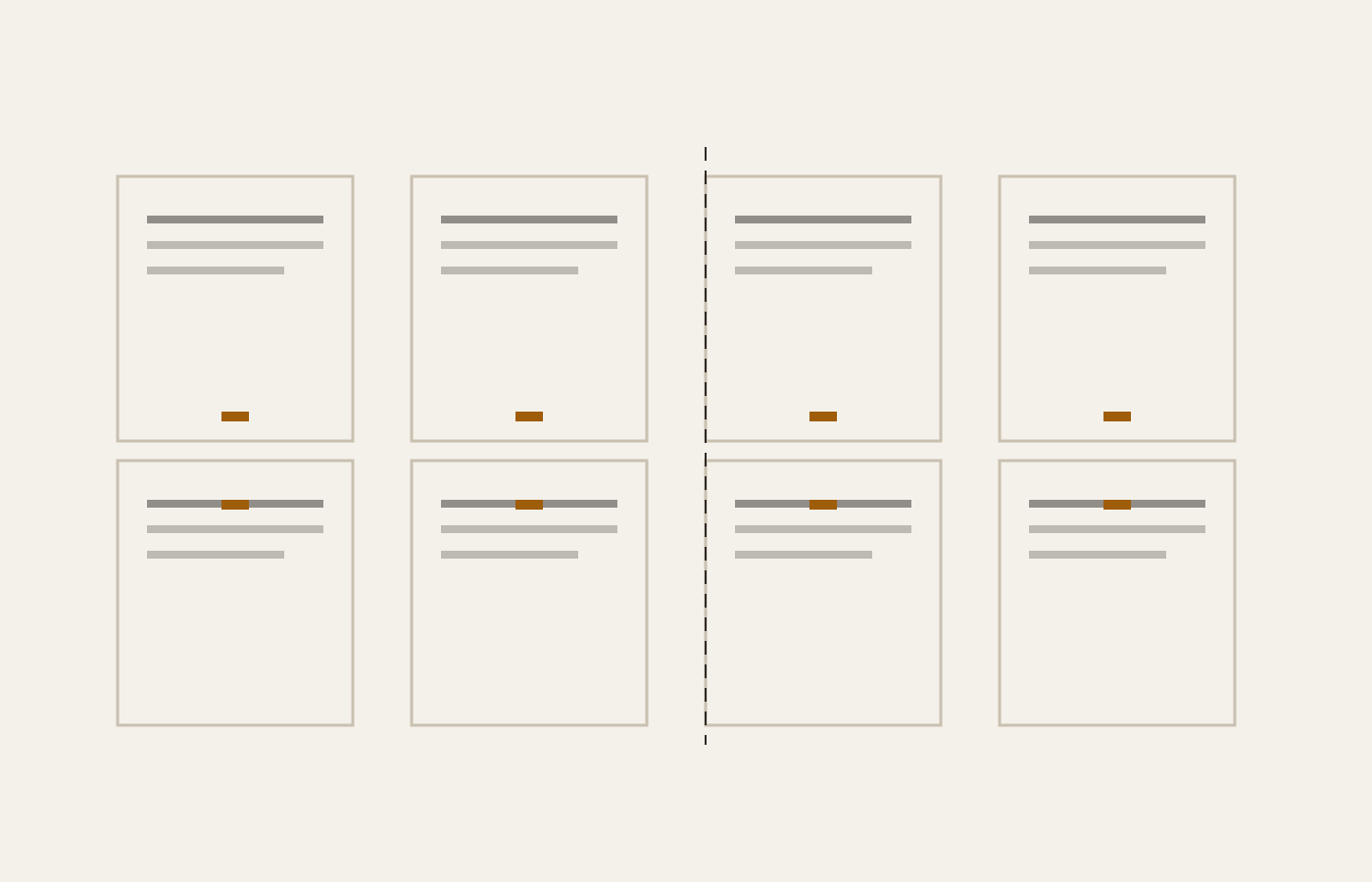
The scheme has a name for every fold count — folio for one, quarto for two, octavo for three — and the names leaked into everything from book sizes to paper grades. When a bookseller calls a volume an octavo they are quoting, at four hundred years' distance, the number of times a printer folded a sheet.
The whole vocabulary is one doubling sequence, which is why it never needed writing down to survive:
| Folds | Name | Leaves | Pages | Typical height |
|---|---|---|---|---|
| 1 | folio | 2 | 4 | 380 mm — a lectern book |
| 2 | quarto | 4 | 8 | 280 mm — a large atlas |
| 3 | octavo | 8 | 16 | 230 mm — the hardback |
| 4 | sextodecimo | 16 | 32 | 170 mm — the pocket book |
Every row halves the page and doubles the count, so the sheet size and the book size are one decision, not two. A publisher choosing "octavo" was choosing the paper bill and the shelf height in the same word.
Why it survives digital
Because folding survives. A book printed today on a digital press is still imposed, still folded into gatherings, still trimmed on three edges. The arithmetic did not change when the plates did.
The part that bites
Creep. The pages at the centre of a folded gathering stick out further than the ones on the outside, because they travel around more paper. On a thick gathering the trim removes more margin from the inner pages than the outer, so the margins you drew are not the margins you get.
The fix is to shift each page slightly inward as it approaches the centre of the gathering. Every imposition tool does this and every first-time self-publisher discovers it after the proof arrives.