Uncials, half-uncials, and the shape of a slow hand
The roundest letters in the Latin tradition were written by scribes who had all the time in the world and no lower case to write with. What they left is a hand with almost no ascenders and a rhythm nothing since has matched.
Uncial is what happens when a formal alphabet meets a pen that prefers curves. Roman capitals were cut in stone, and their straight strokes and sharp corners are a chisel's preferences. Move the same alphabet onto vellum with a broad nib and the corners round off, because rounding is faster and the pen resists the turn.
The result, from about the fourth century, is a hand of wide round letters with almost no ascenders or descenders, written between two lines rather than four.1 It is unmistakable and it is slow: an uncial page is a page somebody spent a week on.
Half-uncial is where lower case comes from
Half-uncial let the strokes run above and below the writing line. The b, d, h and l grew ascenders; the p and q grew descenders. That is the moment the two-case alphabet becomes possible, several centuries before anyone treated the cases as different alphabets rather than different formalities.2
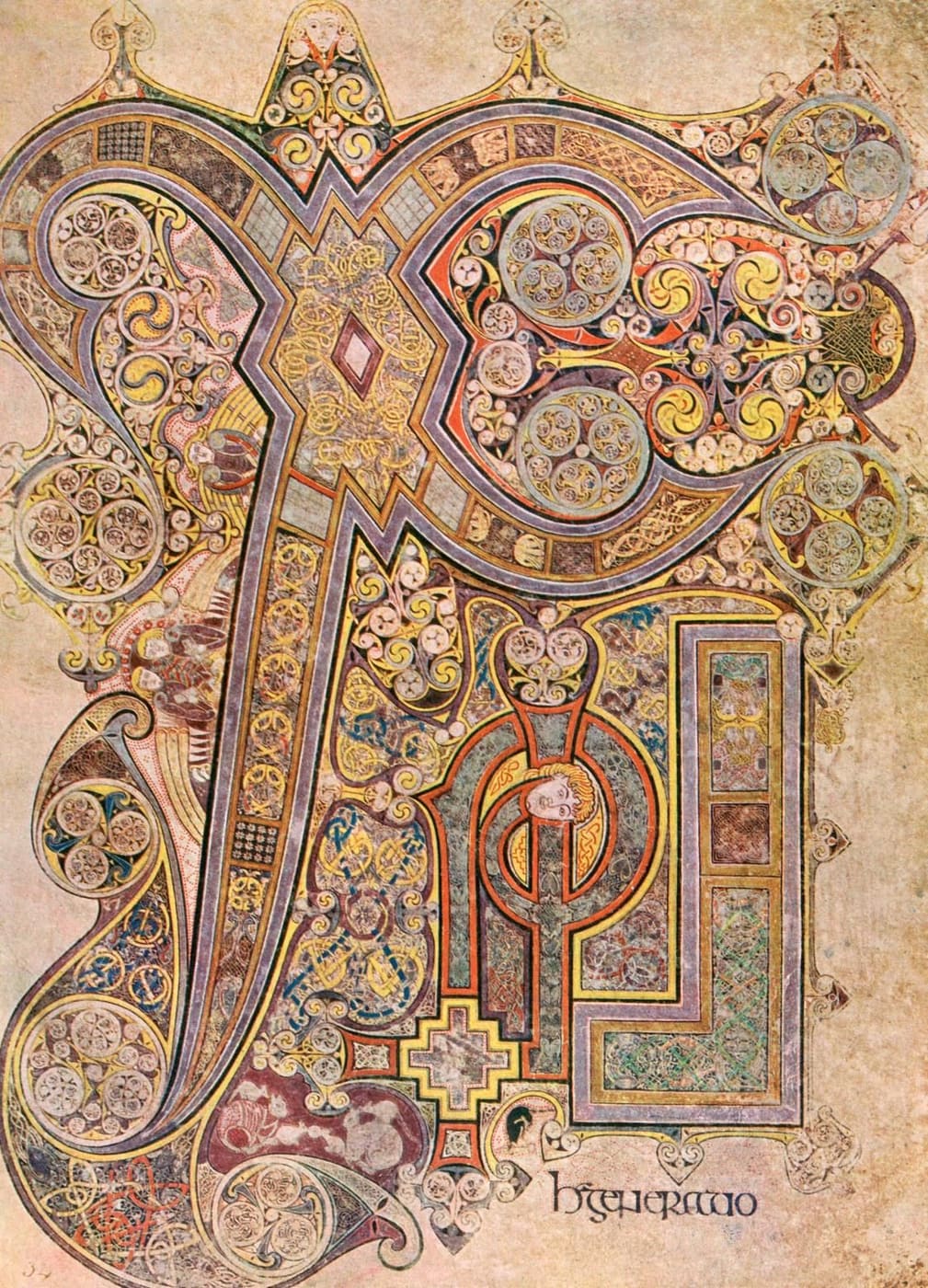
Insular half-uncial — the Irish and Northumbrian variety, the hand of the Book of Kells — pushed it furthest, and it is where the shape of our g was settled.
Reading a real page
The folio beside this paragraph is the most famous page of the most famous half-uncial book: the Chi Rho monogram of Kells, where the text of Matthew reaches the name of Christ and the scribe stops writing and starts building. Three letters — chi, rho, iota — swallow the page.
Look past the ornament at the small text worked into it and the hand is exactly what the exercise below teaches: a flat angle, wide bowls, and that decisive round e and low-slung g. The spectacular page and the practice page are the same hand at two speeds, and it is more useful to study the ordinary lines than the initial — the ordinary lines are the ones a scribe could keep up for three hundred folios.
Writing one
Nib angle very flat, between five and fifteen degrees, which is the whole difference from every later hand. Keep the letters wide: an uncial o is a full circle, not the oval an italic wants. Resist the urge to add slope. There is none.
The hard part is not the letterforms, it is the pace. Uncial punishes speed in a way a running hand does not, because every curve is a slow, even turn and any hesitation shows as a flat spot on the arc.
What it is good for now
Very little, honestly, and that is fine. It is the clearest way to feel what a nib angle does, because at five degrees the tool's behaviour is exaggerated to the point of being obvious. Ninety minutes of uncial teaches more about stress and contrast than a week of reading about them.
- The name is from Jerome, who used uncialibus litteris dismissively — roughly "inch-high letters" — complaining about scribes wasting vellum on show. The name for the hand comes from a complaint about it. ↩
- Mixing the cases as a matter of grammar rather than display is Carolingian, and later still. For centuries a scribe chose a hand for the whole page, not a case for the word. ↩